

2026-10-22
Indoor playground equipment cost is only one part of the money needed to open a commercial play venue. A complete startup budget also needs to account for the building, installation, professional reviews, operating systems, staffing, and other launch expenses.
Before comparing prices, define the purchase: a small toddler corner, a multi-level soft-play structure, or a family entertainment center with several attraction categories. Then separate the equipment quotation from the wider project budget.
The most useful question is not simply, “How much does an indoor playground cost?” It is, “What equipment and services does this price include, and what remains my responsibility?”
This guide explains the main cost factors, provides an illustrative budget, and shows how to prepare a quotation request that supports a realistic investment decision.
For planning purposes, divide your budget into three levels.
Equipment supply covers the specified play structures, components, and agreed finishes. Confirm whether the quotation includes flooring, accessories, spare parts, packing, and documentation.
Delivered and installed equipment adds the agreed transport, handling, assembly, and handover services. Do not assume these are included simply because the supplier describes its service as “one-stop.”
Total opening cash includes the equipment package plus premises preparation, deposits, professional fees, pre-opening expenses, contingency, and an operating reserve. Separating initial expenses from recurring expenses follows the budgeting approach recommended by the U.S. Small Business Administration.
Ask every supplier to identify inclusions and exclusions in writing. A quotation becomes useful when you can place it into the project budget without guessing which costs remain outside it.
A square-meter figure is incomplete without a clear denominator. Ask whether it refers to the equipment’s ground footprint, the designated play zone, or the entire premises.
Consider a hypothetical $60,000 equipment package occupying 180 m² inside a 300 m² venue. The same package equals approximately $333 per square meter of equipment footprint—or $200 per square meter of total venue area.
Neither calculation changes the price. Mixing the two makes comparisons misleading.
Request a dimensioned plan showing equipment, circulation, seating, reception, storage, and other supporting spaces. Compare quotations against the same marked plan.
Multi-level soft-play structures depend on adequate clear height. Building layout and open sightlines also affect how a venue can be arranged and supervised.
Provide measured heights beneath beams, ducts, and other obstructions—not just the landlord’s advertised ceiling height. Ask your project team to review floor condition, delivery access, utilities, and the proposed installation method.
An inexpensive equipment layout is not necessarily economical when it requires substantial changes to the building.
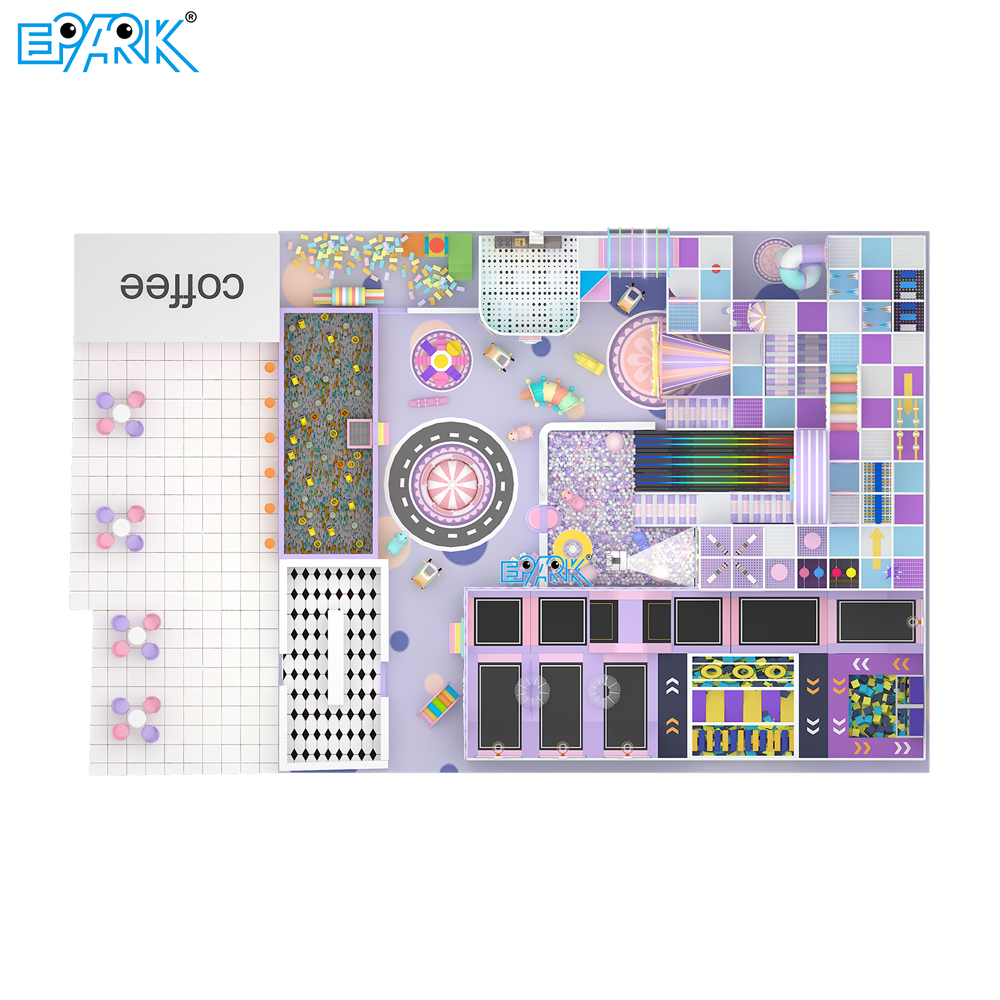
Choose equipment around the intended experience rather than the longest possible feature list.
Use the following table as a purchasing framework. It identifies questions to resolve, not universal price rankings.
| Equipment configuration | Questions affecting the quotation | Budget-control approach |
|---|---|---|
| Toddler soft-play zone | Which age range, components, boundaries, and surfaces are specified? | Price a defined component list |
| Multi-level contained structure | How many levels, access points, slides, and connecting features are included? | Compare layouts with equivalent scope |
| Ball-play area | Does the package include balls, containment, access, and cleaning provisions? | Separate initial supply from replenishment |
| Themed role-play area | Are façades, furniture, props, and decorative finishes included? | Distinguish essential activities from decoration |
| Interactive digital attraction | Which hardware, software, support, and renewal costs apply? | Request both purchase and recurring costs |
| Climbing, trampoline, or other specialist attraction | What additional design, inspection, training, and support are needed? | Treat it as a separate project package |
For a first venue, consider a coherent core offering before adding several specialist attractions. Each addition should have a clear audience, operational plan, and place within the budget.
EPARK’s commercial soft-play range can provide a starting point for comparing configurations before requesting a site-specific proposal.
A rendering cannot establish the quality or safety of the finished structure. Request written specifications for structural components, protective padding, coverings, netting, connectors, and relevant surfaces.
For soft-contained play equipment, ASTM F1918 addresses subjects including materials, performance, structural integrity, access and egress, maintenance, and fire safety. It is a performance specification—not a simple checklist of material thicknesses.
Ask the supplier to explain how the proposed configuration meets the requirements identified for your project. Do not treat thicker steel, denser foam, or a material sample alone as proof that the complete installation is suitable.
For flooring, confirm the specified system, installation scope, and evidence relevant to its intended use. Avoid substituting decorative flooring for a specified protective surface without professional review.
Request a demonstration of how wear components are inspected and replaced. Establish whether coverings, padding, connectors, and other service items can be ordered individually.
These questions make your indoor playground equipment cost estimate more useful because they connect purchase decisions with future maintenance obligations.
Separate customization into functional changes and decorative changes before requesting prices.
Functional changes include adapting the layout to columns, access points, age zones, and other site constraints. Decorative changes include color schemes, graphics, sculpted features, and bespoke façades.
Ask for a base proposal and separately priced options. This allows you to see what each upgrade contributes rather than approving one bundled figure.
For example, compare a standard modular layout with coordinated colors against the same layout with extensive custom decoration. Then assess the additional expense against your branding priorities—not an assumed increase in ticket sales.
Agree on the drawing revision and specification before production. Record the price and schedule consequences of later changes so that design development does not become uncontrolled spending.
For soft-contained play systems, ASTM F1918 is a relevant reference. Its scope excludes several other categories, including amusement rides and certain sports equipment, so it should not be treated as blanket coverage for every attraction inside an entertainment center.
For fully enclosed play equipment, BS EN 1176-10:2023 provides additional safety requirements and test methods. Have a qualified reviewer identify the standards and requirements applicable to each part of your project.
Request documentation that identifies the equipment, configuration, intended users, and scope of assessment. A report for a different product does not establish that your proposed installation has been assessed.
Equipment safety is not the entire compliance task. For U.S. projects, the Access Board’s play-area guidance includes specific accessible-route provisions for soft-contained play structures. Other markets require review against their applicable local framework.
Before ordering, ask the relevant local professionals and authorities to confirm building use, fire and evacuation provisions, accessibility, and required inspections. Obtain project-specific insurance advice as well.
Include the resulting design, review, and inspection costs in the budget rather than leaving them until installation is complete.
For imported equipment, record the agreed delivery term, named location, currency, and quotation validity. ICC’s Incoterms rules allocate transport-related costs, risks, and obligations between buyers and sellers.
Request a written allocation for freight, insurance, clearance, destination handling, local delivery, and unloading. Ask a qualified logistics provider to identify applicable import charges instead of applying a generic percentage from an unrelated project.
Also obtain packing dimensions, weights, and access requirements. Confirm that the goods can reach the installation area—not merely the building entrance.
“Installation support” might describe remote instructions, an on-site supervisor, or a complete assembly team. Ask which service is being quoted and who supplies labor, lifting equipment, tools, travel, and accommodation.
Include handover documentation, operator training, inspection arrangements, and defect correction in the scope. BS EN 1176-7 provides guidance on installation, inspection, maintenance, and operation.
Build the schedule around dependencies: approved design, site readiness, production, transport, assembly, and the required opening checks.
The following example shows how to organize the figures. It is not market pricing, an EPARK quotation, or a recommended minimum investment.
Assume a leased 300 m² venue with a 180 m² equipment footprint. All amounts are hypothetical USD allowances, and each line is separate to avoid double-counting.
| Budget item | Illustrative allowance |
|---|---|
| Play equipment and agreed theming | $60,000 |
| Specified flooring, including its installation | $8,000 |
| Freight, cargo insurance, import charges, and local delivery | $12,000 |
| Equipment assembly, lifting, and crew expenses | $10,000 |
| Building fit-out and utility works | $35,000 |
| Professional reviews, permits, and opening inspections | $7,000 |
| Reception furniture and booking systems | $8,000 |
| Pre-opening rent, deposits, insurance, training, and marketing | $15,000 |
| Pre-opening subtotal | $155,000 |
| Project contingency | $15,000 |
| Opening operating reserve | $30,000 |
| Illustrative initial cash requirement | $200,000 |
This example excludes property purchase, a full commercial kitchen, and financing costs. Schedule any additional tax cash requirements separately with your accountant.
The important distinction is that the $60,000 equipment allowance is not a $60,000 opening budget. Deposits and unspent reserves are also cash requirements, not necessarily accounting expenses.
Keep contingency and operating reserve separate. Contingency addresses project uncertainty; the operating reserve supports the business after opening. Replace every allowance with project-specific quotations and cash-flow assumptions before committing funds.
A purchase decision should include the resources needed to keep the equipment operating. Inspection and maintenance planning are addressed in BS EN 1176-7, alongside installation and operation.
Request a maintenance schedule, wear-parts list, replacement prices, and service arrangements. Ask your operating team to estimate the labor needed for inspections, cleaning, supervision, and customer service.
Compare configurations over a defined ownership period. Include purchase, installation, service, replacement components, and any software or support subscriptions. Keep revenue assumptions separate from these costs.
A basic break-even calculation divides fixed costs by the contribution from each sale. The SBA explains this as fixed costs divided by selling price minus variable cost.
For a simplified hypothetical example, assume monthly fixed operating costs of $18,000 and contribution of $12 per paid visit. The operating break-even point is 1,500 paid visits per month.
That is not an investment-payback forecast. The example excludes financing, income tax, and recovery of the initial project investment.
Use realistic discounts and attendance assumptions. Allocate membership, party, and admission revenue consistently so the same income is not counted twice.
From a supplier’s perspective, a measured floor plan and clear operating brief provide a stronger basis for estimating than reference photographs alone.
Provide the destination, venue dimensions, usable height, target age groups, proposed attraction mix, budget boundary, and opening objective. Identify which building works and local services will be handled separately.
For a customization project, resolve functional requirements before finalizing decorative details. A theme can be discussed meaningfully only after the equipment layout and service scope are clear.
| Purchasing stage | Required decision or document |
|---|---|
| Define the project | Agreed venue, audience, scope, and budget limit |
| Review the concept | Dimensioned layout and equipment list |
| Compare suppliers | Matching specifications and itemized exclusions |
| Approve the purchase | Final drawings, responsibilities, schedule, and payment terms |
| Accept the installation | Documented checks, training, handover, and outstanding-item resolution |
EPARK supplies soft playground and commercial amusement equipment and offers project support including layout proposals, 3D design, installation, and after-sales services. Its published services also include equipment proposals based on the customer’s audience and budget.
Use that support to compare a focused core installation with separately priced additions. Ask for the tradeoffs in writing: equipment scope, space requirements, maintenance needs, and delivery responsibilities.
EPARK’s layout and 3D design support should not be assumed to include local architectural submissions, statutory approvals, or every building service. Confirm the contracted scope and retain the appropriate local professionals.
Reduce unnecessary scope before reducing safety requirements. An optional decorative feature can be deferred; required protective measures and approval work cannot simply be removed to meet a target price.
Request a rate tied to a defined layout and scope. Confirm whether the area means equipment footprint, play-zone area, or total premises. A square-meter rate without those details is not enough to compare suppliers.
Check the contract rather than assuming inclusion. Ask for separate delivery and installation responsibilities, with the applicable trade term and named delivery location. Incoterms help allocate transport obligations, but the assembly service should also be expressly defined.
Do not assume so. Standards have defined scopes: ASTM F1918 addresses soft-contained play equipment, while BS EN 1176-10 addresses fully enclosed play equipment. Have the full attraction mix and venue requirements reviewed separately.
Request separately priced options, simplify decoration, and compare a smaller opening configuration with later expansion. Keep the agreed safety specification unchanged. Ask the designer to verify that any phased plan remains suitable at each stage.
Base the reserve on a conservative cash-flow forecast rather than a fixed percentage of equipment price. Model recurring expenses and realistic receipts month by month, including a delayed-opening scenario. The SBA recommends considering both one-time and monthly expenses when planning funding needs.
Provide a dimensioned floor plan, usable heights, site photos, destination, target age groups, preferred activities, and budget limit. State whether you need equipment supply only, delivered equipment, installation, or broader project support.
A useful indoor playground equipment cost estimate connects the equipment specification with the venue, delivery plan, compliance review, and operating resources.
Begin with a clearly defined core offering. Compare like-for-like quotations, price optional additions separately, and retain cash for project uncertainty and the opening period.
The strongest proposal is not necessarily the lowest equipment price. It is the proposal whose scope, responsibilities, and exclusions you understand well enough to place inside a complete project budget.
Share your floor plan, destination market, target age groups, and budget with EPARK to request a layout proposal and itemized quotation. Ask for equipment, logistics, installation, and support to be clearly distinguished so you can evaluate the full investment.


